Selling a med spa to a private equity-backed buyer can involve a range of deal structures. Some include cash at close with a portion rolled into equity in the platform, and many allow the seller to stay on in a clinical or leadership role while the platform continues to grow toward a future sale. The right structure depends on the specific buyer and the specific practice, which is something a real conversation with an advisor can help sort through.
If you have received an offer from a private equity-backed buyer, there is one thing you should know before you respond: Their deal team has run this process dozens of times. You probably have not run it once.
That information gap is worth real money. Sellers who go into a deal with a PE-backed buyer without a specialist advisor often leave real money on the table, sometimes a significant amount relative to the size of their practice. Having the right advisor negotiate on your behalf is one of the clearest ways to protect your outcome. This guide explains exactly how PE-backed deals work, what buyers are actually buying and what you need to know before you sign anything.
Why Private Equity Is Flooding Into the Med Spa Industry Right Now
Private equity has been quietly building positions in the med spa industry for several years, mostly through the MSOs and platforms it backs rather than through direct acquisitions. The numbers explain why. The US med spa market was valued at over $18 billion in 2024 and is projected to reach $49 billion by 2030 at a 15% annual growth rate. That kind of growth in a fragmented, cash-pay industry is exactly what PE firms look for. And the fragmentation is striking: over 90% of US med spas are still independently owned, with only 3% to 4% currently PE-consolidated (American Med Spa Association, 2024 State of the Industry).
The investment thesis is straightforward. PE firms invest in or acquire strong platforms, which then pursue smaller add-on acquisitions to build a regional or national brand. As the combined platform grows, it may eventually sell or recapitalize at a higher valuation. That gap between the buy multiple and the sell multiple is where PE makes its money. Active examples include Empower Aesthetics (backed by Shore Capital), Advanced MedAesthetic Partners (Leon Capital), MedSpa Partners (backed by Morgan Stanley PE with a $275 million continuation fund) and Princeton Medspa Partners, which acquired 10 clinics since 2022 with a $120 million investment from BC Partners. These platforms, not the PE firms themselves, are who most sellers actually negotiate with.
Does Your Practice Actually Qualify for a PE-Backed Deal?
Most med spa owners assume PE is for someone else. That is not accurate. PE-backed buyers are acquiring practices across a wide range of sizes, from single-location add-ons to regional platforms. What matters is not how big you are but whether your practice fits the criteria these buyers use to underwrite risk.
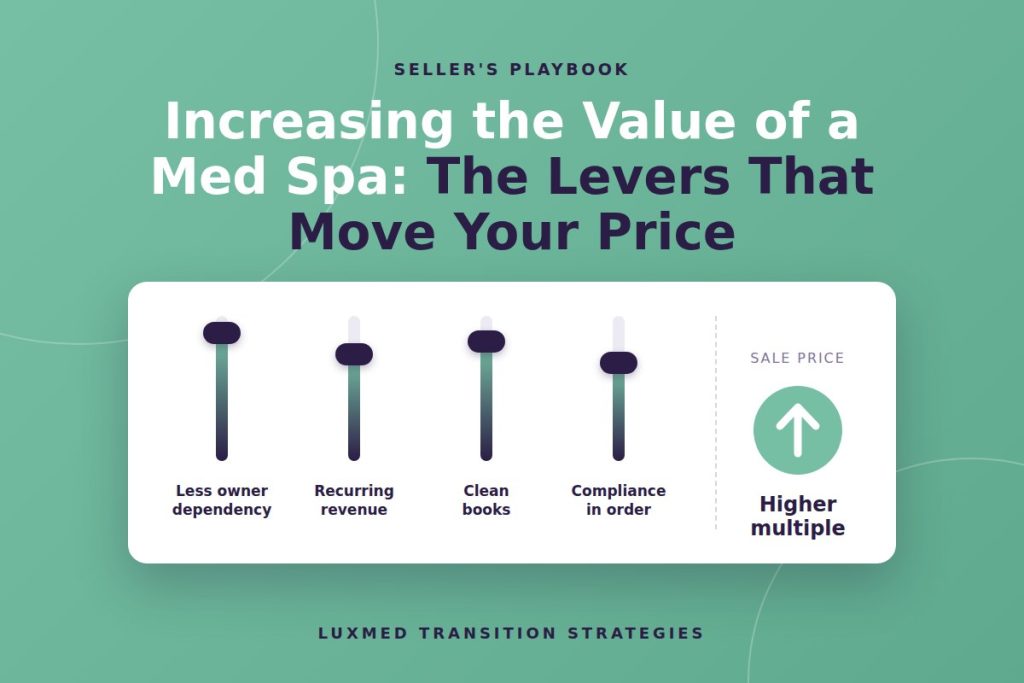
Here is what PE-backed buyers generally look for: strong, consistent financial performance; strong bench of highly utilized clinicians and injectors so the business does not collapse if one person leaves; recurring revenue that creates predictable cash flow; clean financials with at least two to three years of organized records; and operational systems that run without the owner in the room every day.
The single most disqualifying factor is owner dependency. If the practice is heavily dependent on you personally to perform treatments and generate revenue, PE-backed buyers may view that as a significant risk. They are not buying your skills. They are buying a transferable business. If the business cannot run without you, the multiple drops, sometimes dramatically.
That said, single-location practices do qualify for PE-backed add-on deals. Your practice size determines which tier of buyer you attract (an MSO add-on versus a larger platform), not whether buyers exist at all.
How PE-Backed Buyers Actually Value Your Med Spa
A lot of owners assume their practice value is simply their revenue multiplied by some arbitrary number they heard at a conference. That is not how buyers actually think about it.
What a PE-backed buyer is really trying to figure out is how much reliable, transferable profit your practice produces and how confident they can be that it keeps producing it after you leave. That assessment starts with your collections but it does not end there. Location matters, the services you offer and their margin profile matter, how stable your staff is matters, how your compliance is structured matters and how dependent the business is on you personally matters. All of those things factor into how a buyer sizes up your practice before they ever put a number on it.
From there, buyers apply a multiple to your adjusted EBITDA, which is your practice’s earnings before interest, taxes, depreciation and amortization, normalized to remove owner-specific expenses and one-time costs. It is worth noting that institutional buyers generally value practices based on adjusted EBITDA and not SDE. Seller’s discretionary earnings is a metric used in smaller, individually financed transactions. Institutional buyers do not use it because they are not buying a job. They are buying a business and EBITDA is the standard that reflects that.
Two practices with identical revenue can receive dramatically different valuations. The factors that push a multiple toward the bottom of the range are well documented. The owner performs most treatments, a single provider drives a large share of revenue, staff are misclassified as 1099 contractors and the corporate structure is undocumented or noncompliant. Collections alone do not determine valuation. A practice doing $3 million in revenue with thin margins and heavy owner dependency will not command the same valuation as one doing $2 million with strong recurring revenue, a real team and clean books.
Even a relatively small difference in the multiple applied to adjusted EBITDA can result in a significant difference in value. Where a practice falls depends on both market conditions and factors specific to the business, including profitability, growth, provider structure and owner dependency.
For a deeper look at how practice value is calculated and what buyers are actually looking for, you can read LuxMed’s comprehensive valuation guide here.
What a PE-Backed Deal Structure Looks Like in Plain Language
Most med spa owners have never seen this kind of deal structure before they are in the middle of one. Understanding the five core components before you receive an offer puts you in a far stronger position.
100% Sale
A full sale, full stop. You may stay on in patient care for a while, or leave immediately, but the business itself is no longer yours to manage.
Joint Venture
You sell most of your practice, typically 60% to 90%, while keeping a real ownership stake. You get capital up front and still have a say as the practice grows.
Equity Roll
Instead of taking your proceeds entirely as cash, you convert a portion into ownership in the acquiring platform. Your day-to-day role winds down, but you stay tied to how well that larger group performs going forward. If the platform later sells at a higher valuation, that stake pays out again, which is what people in this industry call a second bite of the apple. Treat that future payout as a possibility, not a promise, since your cash at close is the only number you can count on today.
Sub-MSO
Instead of being folded into a larger platform, you become the foundation for a new regional group under it. A private equity partner provides the capital and back-office support, and your practice serves as the hub that other med spas join. You typically keep meaningful ownership in that regional group and take on a bigger leadership role, not a smaller one. This path fits owners who want to grow rather than step back, but it means more responsibility, and your eventual payout depends on how well that group performs under your direction.
The Three Moments Where Sellers Lose the Most Money
Most articles about these deals focus on the steps to get to closing. This section focuses on where value actually gets destroyed in practice, because understanding these moments is worth far more than knowing the steps.
The first is responding to an unsolicited offer without representation. PE-backed buyers send direct outreach to practices they have already modeled financially. An unsolicited offer gives one buyer the opportunity to set the value and the terms without competition. Without other buyers at the table, there is no market pressure pushing that buyer to improve its offer. A competitive process changes that dynamic by requiring buyers to compete on both value and deal structure. Sellers who engage directly, without a broker, are negotiating against a team that has run this exact process dozens of times. The outcome is predictable.
If you have already received an unsolicited offer from a PE-backed buyer:
Do not respond substantively until you have spoken with a sell-side advisor who specializes in med spa transactions. Do not sign an NDA from the buyer’s template without having it reviewed. Some NDAs contain language that limits your ability to market your practice to other buyers. A five-minute conversation with the right advisor before you respond can protect significant value.
Here is what a lot of owners do not realize: Bringing in an advisor at this stage does not mean walking away from the offer you already received. It usually means the opposite. The right advisor puts your practice in front of a competitive field of buyers, and that competition alone tends to push the original buyer to improve their offer.
We have repeatedly seen owners end up transitioning to the exact same group that made the unsolicited offer in the first place, just at meaningfully better terms, because that group had to compete for the deal instead of naming their own price.
The second common mistake is signing an LOI without negotiating the right terms. The Letter of Intent is where the real deal gets set: exclusivity window length, earnout structure, rollover percentage, and the scope of representations and warranties.
Most sellers treat these as standard terms. They are not. What gets negotiated before the LOI is signed is very difficult to revisit once exclusivity begins and the buyer’s lawyers are drafting the purchase agreement. An experienced advisor negotiates these terms before you sign.
The third is getting re-traded during due diligence. Once exclusivity begins, the PE-backed buyer commissions an independent quality of earnings (QoE) review from their own accounting firm, not yours, to validate the EBITDA you represented. Add-backs get challenged. One-time revenue items get stripped out.
Compliance issues surface. Compliance issues discovered during diligence can meaningfully reduce a deal’s value after exclusivity has already begun, sometimes significantly. The preparation you do before going to market is what protects your offer from eroding before the wire clears.
Selling to an MSO: What Most Owners Will Actually Encounter
Most owners hear “private equity” and picture a PE firm buying their practice directly. In practice, that is rarely how it happens for a single-location practice. An MSO, an operating company that manages the non-clinical side of your practice, is usually the buyer you will actually be dealing with. Many MSOs are themselves backed by institutional capital, so the PE money is still in the picture, it just arrives through the MSO rather than as a direct buyer.
This matters because where the industry stands right now in its consolidation cycle, there are far more MSOs actively acquiring than there are practices large enough to attract direct PE investment on their own. For most sellers, an MSO deal is not a fallback option. It is the realistic path.
The specific deal structure will vary depending on who is on the other side of the table and may include cash at close, rollover equity, earnouts and the rest. The real difference is what happens after closing. An MSO may take over or provide support for areas such as billing, staffing, marketing and compliance, so you can stay focused on patient care. That operational support is often exactly what owners are hoping for when they consider a sale in the first place.
At LuxMed, we help you understand what a specific PE backed offer actually looks like for your practice before you sign anything. Most owners who end up unhappy with their deal structure discovered a mismatch after the fact. Understanding what you are actually agreeing to, and who is really behind the deal, is the most important decision in the entire process.
What Life Looks Like After a PE-Backed Deal Closes
Most of the content about these deals stops at closing. But the closing is just the beginning of a new chapter that owners need to understand going in.
You may stay on in a clinical or leadership role after closing, depending on the buyer and deal structure. Many buyers value continuity and may ask the owner to remain involved for a period of time.
This is not always a negative. Many owners report that having the operational weight lifted while staying in the clinical work they love is exactly what they wanted. But it is a commitment, and the terms of that commitment, including compensation, decision-making authority and what happens if you want to leave early, should be negotiated before you sign.
Day-to-day operations may change. HR, vendor contracts, marketing budgets and pricing decisions generally shift to the platform. That is the tradeoff for the payout and the infrastructure the buyer brings. Owners who are comfortable with that tradeoff tend to thrive in these environments. Owners who expected to retain operational control often find the transition harder than they anticipated.
If your deal includes rollover equity, its future value will depend on the performance of the larger platform. If the platform later sells or goes through a recapitalization, that equity may provide an additional return. That second event can be meaningful if the platform performed well and the exit multiple is strong. Early-stage partners who joined growing platforms before they reached full scale have seen rollover equity produce significant returns. The outcome is not guaranteed, but the structure is designed to give you a stake in the upside you helped create.
Ready to find out what buyers would actually pay for your practice?
Contact LuxMed Transition for a free, confidential valuation. No upfront fees. No commitment. Just a clear picture of your options before you make any decisions.
Frequently Asked Questions
What is rollover equity in a med spa PE-backed deal?
Rollover equity is the portion of your sale price you reinvest into the platform instead of taking as cash at close. If the platform later sells at a higher multiple, your rolled equity may provide an additional return.
Do I need a broker to sell my med spa to a PE-backed buyer?
Not legally, but PE-backed buyer deal teams are experienced negotiators who have run this process many times. Having a specialist on your side levels the playing field and protects your price through the diligence process.