Selling a med spa typically involves getting a professional valuation and identifying the right buyer type well before going to market, to maximize what you walk away with.
Most med spa owners think about selling for years before they do anything about it. That hesitation is costly. Not because waiting is always wrong, but because sellers who prepare ahead consistently walk away with significantly more money than those who try to move fast.
This guide covers the full process: how your practice gets valued, who the real buyers are, what an MSO deal looks like and what separates a premium exit from an average one.
The Market Timing Med Spa Owners Can’t Afford to Ignore
The med spa industry is growing fast. The US market was valued at $24.2 billion in 2025. It is projected to reach $78.2 billion by 2033, a growth rate of nearly 16% per year (Grand View Research, 2026). That kind of growth attracts buyers — lots of them.
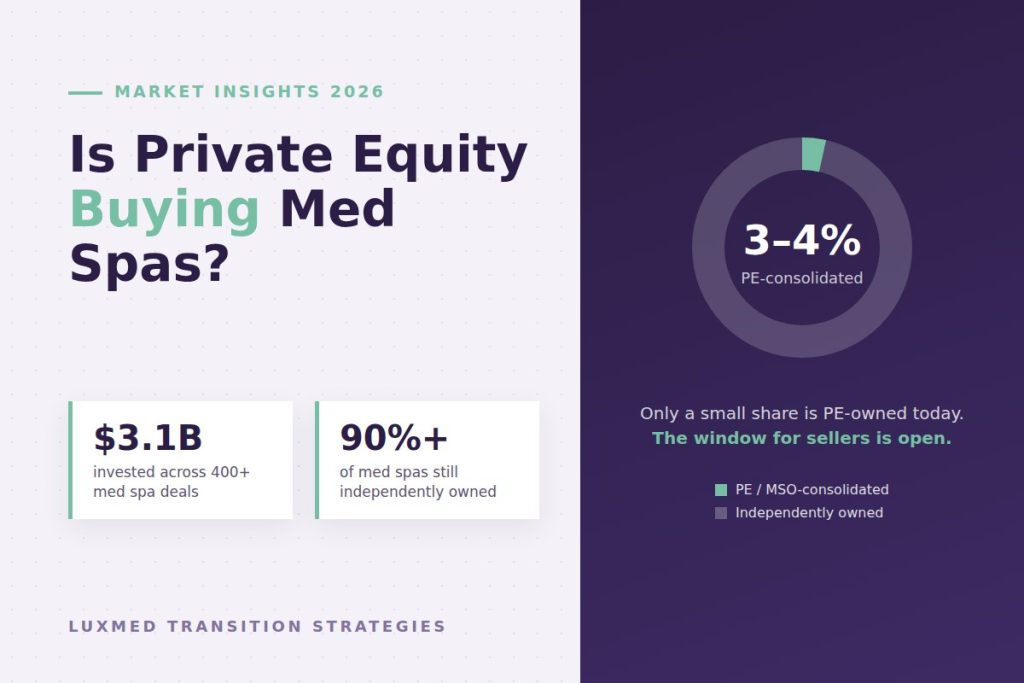
Right now, more than 90% of US med spas are still independently owned (American Med Spa Association, 2024 State of the Industry). That means buyers, including PE-backed and independent MSOs actively building national platforms, are hunting for good practices with limited supply. The American Med Spa Association suggested 2026 as a record-breaking year for med spa mergers and acquisitions.
That is good news for sellers. But it will not last forever. Consolidation cycles always close and they only happen once in an industry’s lifecycle. Owners who move while demand is high get better prices, more competitive offers and stronger deal terms. Owners who wait until demand cools often regret it.
What Your Med Spa Is Actually Worth and How Buyers Calculate It
There is no single formula for determining what a med spa is worth. How your practice is valued depends in part on the type of buyer. PE-backed buyers and MSOs typically value practices based on adjusted EBITDA, while individual buyers generally look at seller’s discretionary earnings (SDE) and annual collections.
For PE-backed buyers, the numbers are only part of the equation. They also look at how transferable the business is. A practice with strong profitability, multiple providers, clean financials, documented processes and a management structure that does not depend entirely on the owner is generally more attractive to this type of buyer.
Owner dependency can have a significant impact on value with a PE-backed buyer specifically. If the practice relies heavily on you to generate revenue or manage day-to-day operations, this type of buyer has to consider what happens when your role changes after the sale. Building a strong provider team and creating systems that allow the practice to operate without your constant involvement can reduce that risk and strengthen your position with PE-backed and MSO buyers.
Understanding the Different Buyers for Your Med Spa
Not all med spa sales look the same. There are three main paths. Each one fits a different type of owner and a different set of goals.
Partnering With an MSO
An MSO, short for medical support organization, is a company that takes over the business operations of your practice. Most MSOs are backed by institutional capital, private equity or similar investors, which is what funds their growth and their ability to acquire practices like yours. Think HR, billing, compliance, marketing and vendor contracts. You keep doing what you are trained to do: treating clients. The MSO handles everything else.
This matters for your sale in a big way. MSO deals can include rollover equity as one of several possible deal structures. This means part of your sale proceeds gets reinvested into the platform instead of paid out entirely in cash. If that platform later sells to a larger group or goes through a recapitalization, you may get paid again. People in this industry call that a second bite of the apple, though it depends on how the platform performs and isn’t guaranteed.
MSO deals, like many PE deals, also let you stay on in a clinical role. Most owners continue treating patients after the deal closes. They earn a salary, keep their patient relationships and benefit from the MSO’s infrastructure making the whole operation run better. Many owners end up making more through an MSO deal than through any other exit type. That includes the upfront cash, the continued income and the second payout combined.
Selling to an Individual Buyer
This means selling to another practitioner, a nurse practitioner or simply an individual business owner looking to enter the industry. It is the simplest exit. The process is usually faster and less complicated. But individual buyers have limited financing, which means the price is typically lower. This works best for smaller practices or owners who want a clean break without a lot of negotiation.
A Note on Legal Structure
In many states, laws restrict who can own the clinical side of a medical practice. This is called the Corporate Practice of Medicine doctrine. It is one reason MSO structures exist. The MSO owns and operates the non-clinical side, while a licensed physician or physician-owned entity retains clinical control. Getting this structure right before going to market matters. Issues found during due diligence give buyers leverage to reduce price or walk away. A good broker helps you navigate this before you ever talk to a buyer.
Why MSO Deals Often Put More Money in Your Pocket
Once you understand what an MSO is, here’s why this path often works out better financially for most med spa owners.
First, an MSO can bring shared HR support, better buying power, marketing help and other operational resources. This additional infrastructure can help support the practice’s continued growth after the sale. If part of your deal is an earnout tied to future performance, a better-run practice means a bigger payout.
Second, some MSO deals include rollover equity. How that equity is structured matters. Some deals tie your equity to your own practice’s performance. Others tie it to the whole platform. Some do both, allowing you to benefit from your own growth and potentially the platform’s growth if it later sells or goes through a recapitalization. Owners who join a growing platform early have often seen their equity grow significantly. The American Med Spa Association noted in May 2026 that early MSO partners are well positioned as more platforms reach this stage.
Third, many MSO deals let owners keep treating patients for two to five years after the sale, while receiving additional support with functions like payroll, HR or marketing budgets, often the exact setup most owners wanted when they opened their practice. The specific role, responsibilities and length of the transition vary by buyer and deal structure.
Preparing to Sell: The Moves That Separate a Premium Exit From an Average One
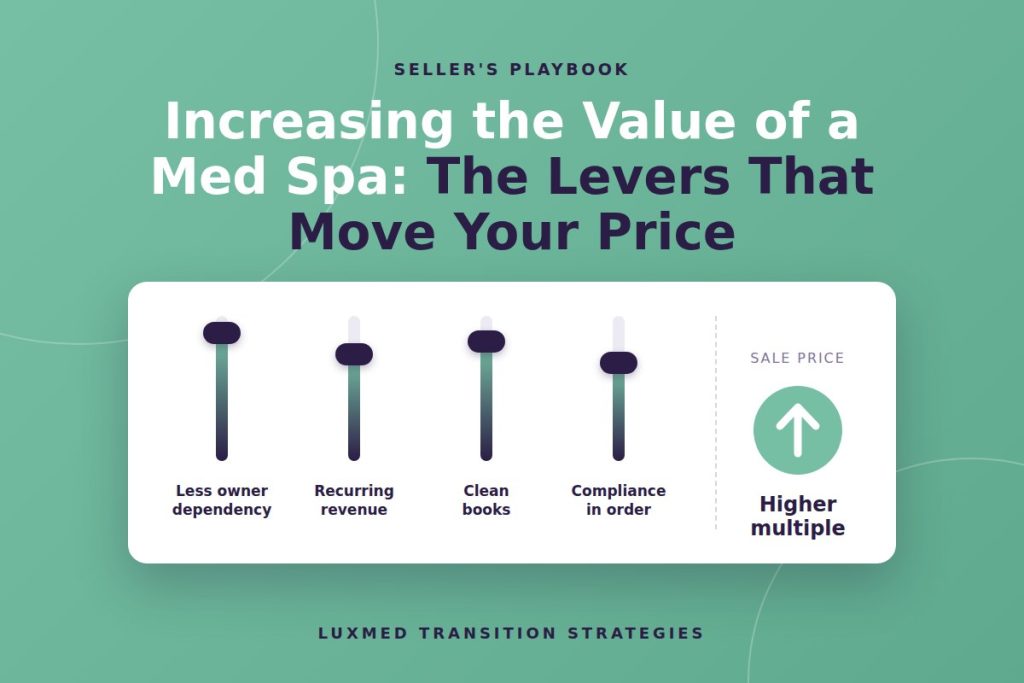
The way you prepare before going to market can have a bigger impact on your final sale price than almost anything else. Here are the four moves that matter most.
-
Reduce owner dependency. If you are performing most of the treatments yourself, start building a stable provider bench now by cross-training your existing staff and installing a practice manager who can run day-to-day operations without you. Buyers discount practices where the owner is the practice, since that risk doesn’t go away once they take over. Removing that dependency is one of the most reliable ways to strengthen your final sale price, and a real valuation can show you exactly how much this specific change could be worth for your practice.
-
Clean up your finances. Get at least three years of clean, organized books. Take personal expenses out of the business accounts, and make a clear list of any legitimate add-backs or one-time costs that would not continue under new ownership. Clean books like this could meaningfully raise your final sale price, since every dollar you can properly account for adds real value to how a buyer sees your practice. That is what makes clean bookkeeping worth the effort.
-
Get your compliance structure right. Ownership and legal structure, medical director arrangements, scope-of-practice documentation and staff classification are all reviewed during due diligence. Problems found late in the process give buyers leverage to cut price or renegotiate terms. Fixing these issues before going to market protects your valuation.
-
Keep the sale confidential. Do not tell your staff or clients you are selling. Word getting out mid-process creates staff anxiety, potential departures and patient uncertainty. Buyers watch all of this closely. A good broker manages all outreach confidentially, sharing enough information to generate buyer interest without revealing the identity of your practice and requiring an NDA before providing the full prospectus, sensitive information or identifying details.
We generally advise owners to start preparing well before they’re ready to leave the business. The more time you have, the more opportunity there is to strengthen financial performance, address compliance issues and demonstrate that those improvements are sustainable. But every practice is different, and a valuation can help identify what changes, if any, could strengthen your position before going to market.
What the Sale Process Looks Like From Start to Close
There is no single timeline that applies to every med spa sale, since the process depends on your specific practice, your buyer type and how prepared you are going in. A well-prepared practice with clean financials and the right documentation in place generally moves through the process faster than one that isn’t. Here is what that process looks like, step by step.
-
Engage a sell-side broker. Start with a broker. A skilled broker who specializes in med spa transitions can run an accurate valuation, knows the buyer landscape, runs a confidential process, and negotiates on your behalf. Having the right advisor consistently produces better outcomes than selling alone.
-
Get a valuation. Know what your practice is worth before you talk to anyone. An accurate valuation sets your expectations, identifies value gaps you can close and gives you a defensible number to anchor negotiations.
-
Confidential buyer outreach. Your broker reaches out to qualified buyers without revealing your identity, and creates a competitive environment among them to drive up offers. Interested buyers sign a non-disclosure agreement before receiving any details about your practice.
-
Review Letters of Intent (LOIs). An LOI outlines a buyer’s offer: price, deal structure and key terms. It is not a final contract. Evaluate LOIs not just on price but on structure: cash at close, earnout terms, rollover equity and what is expected of you post-sale.
-
Due diligence. This is where the buyer’s team reviews everything: financials, patient data, leases, equipment, staff agreements and compliance documentation. Issues uncovered during this stage can lead to renegotiation, or in some cases, cause a deal to fall apart.
-
Definitive agreement and close. Attorneys finalize the purchase agreement. Funding is released. The deal closes. Your transition period begins.
The LOI is not the finish line. Issues uncovered after an LOI is signed can still affect price and deal terms, which is why preparation before going to market and throughout diligence matters.
What a Specialized Med Spa Broker Does That a General Business Broker Can’t
A general business broker can sell a restaurant or a dry cleaner. A med spa is different. It involves compliance, licensing, MSO deal structures and a very specific buyer pool that a general broker does not have relationships with.
A specialized med spa broker understands how different buyers value practices, which MSO and PE-backed platforms are actively acquiring, what they prioritize in a deal and how different deal structures compare. They also understand the common issues that can surface during diligence and work alongside the appropriate advisors to help keep the transaction moving. And they run a confidential process that protects your practice’s value while the deal is happening.
At LuxMed, we represent sellers only. We never represent buyers. That means there is no conflict of interest. Our only job is to get you the best possible outcome. We charge no upfront fees. Our commission is earned only when your deal closes.
Find Out What Your Med Spa Is Worth Before You Make Any Decisions
You do not need to be ready to sell to find out what your practice is worth today. A professional valuation is the single smartest first step. It tells you where you stand, what gaps exist and what moves would increase your number before going to market.
LuxMed offers free, confidential med spa valuations. No pressure. No commitment. Just a clear picture of what your practice is worth and what your options are.
Frequently Asked Questions
How long does it take to sell a med spa?
There is no single timeline that applies to every sale, since it depends on your specific practice, your buyer type and how prepared you are going in. Preparing ahead of time can help address issues that might otherwise slow the transaction or affect value during diligence.
What is an MSO and why do med spa owners sell to one?
An MSO, short for medical support organization, manages non-clinical operations of your practice: HR, billing, marketing, compliance and vendor contracts. Many owners who sell to an MSO stay on in a clinical role and continue treating clients after the transaction. Depending on the buyer and deal structure, an offer may also include earnouts, rollover equity or other components that provide the potential for additional value beyond cash paid at close.
What multiple of EBITDA do med spas sell for?
There’s no single multiple that applies across the board. PE-backed buyers and MSOs typically value practices based on adjusted EBITDA, while individual buyers generally look at seller’s discretionary earnings (SDE) and annual collections. For buyers using EBITDA, the multiple can depend on factors including the practice’s size, profitability, growth, provider mix, owner dependency and overall transferability. A real valuation shows you exactly where your practice stands.
Do I need a broker to sell my med spa?
You are not required to use one. But most owners who sell on their own either underprice their practice or miss out on buyers they did not know existed. A specialized med spa broker finds more qualified buyers, keeps the process confidential, negotiates the deal structure and navigates the compliance issues that can derail a transaction. The broker’s fee is typically earned back many times over in improved deal terms.