Yes, private equity is actively investing in the med spa industry, and much of the acquisition activity happens through PE-backed medical support organizations, or MSOs. In plain terms, private equity firms invest in MSOs and other platforms that acquire and support practices as they grow. These platforms acquired and consolidated practices throughout 2025, and the American Med Spa Association suggests 2026 could be a record-setting year for the industry, driven in part by anticipated platform recapitalizations.
If you have noticed more “Now Part Of” signs in med spa lobbies or heard that a competitor down the street just got acquired, you are not imagining it. Private equity interest in med spas has accelerated in recent years, and 2026 could be a significant year for M&A activity.
Here is what is actually happening, who is doing the buying and what it means whether you own a med spa, work at one or are simply trying to understand where the industry is headed.
The Short Answer: Yes, and It Is Accelerating
Private equity firms have invested approximately $3.1 billion across more than 400 med spa and aesthetic clinic transactions over the past five years (McKinsey). That is not a small trend. That is sustained, serious capital moving into a single industry.
Right now, only about 3% to 4% of med spas are PE-consolidated. More than 90% remain independently owned (American Med Spa Association, 2024 State of the Industry). That gap between a tiny current share and a massive remaining opportunity is the entire story. It explains why PE firms keep showing up, and it explains why the American Med Spa Association noted in May 2026 that 2026 could become a record-setting year for med spa M&A.
Why 2026 Specifically Is a Turning Point
Major PE-backed platforms, often structured as MSOs, that were built between 2018 and 2023 are now reaching a point called recapitalization, or “recap.” This is when a platform undergoes a new financing or ownership event that can provide liquidity to existing investors and bring in additional capital to support future growth and acquisitions. It is essentially the next stage in a platform’s lifecycle, and it tends to trigger fresh waves of buying.
Several major PE-backed platforms are approaching potential recapitalization events. Successful recapitalizations could bring additional capital into the space and contribute to another wave of acquisition activity as platforms continue to grow (American Med Spa Association, May 2026). When platforms like these recapitalize successfully, it validates the entire investment thesis for the industry. That tends to set off renewed buying intensity as competing platforms race to scale before their own exit windows arrive.
Why Med Spas Specifically Caught Private Equity’s Attention
Private equity had plenty of industries to choose from, so why med spas? Four reasons explain most of it.
No reimbursement risk. Med spas are largely cash-pay businesses, which reduces the reimbursement risk found in many other healthcare sectors.
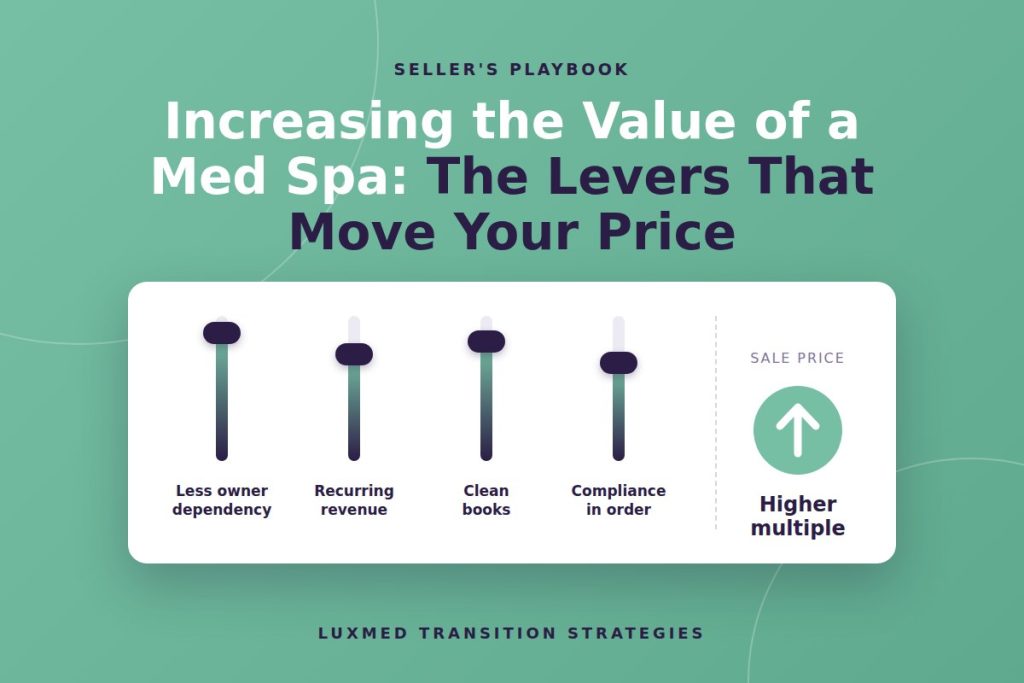
Predictable, recurring revenue. Repeat procedures and injections, along with memberships and prepaid treatment packages, give buyers income that is more predictable.
A fragmented market. Over 90% of practices are independently owned, with no single national brand dominating, leaving enormous room to consolidate.
Steady demand growth. Interest in injectables, laser treatments and non-surgical procedures keeps growing at mid to high single digit rates, even during periods of broader economic uncertainty (American Med Spa Association, 2025).
What PE-Backed Buyers Are Actually Paying
There’s no single number that applies here. Multiples can be presented in misleading ways depending on how a firm calculates and adjusts them, and what a practice sells for depends entirely on its specific EBITDA. A real valuation is the only way to know what your practice is actually worth.
What has changed is the pricing environment itself. The “land grab” era of 2021 to 2023, when buyers chased growth at almost any cost, is over. Buyers in 2026 are more disciplined, focused on compliance, recurring revenue and owner independence rather than topline growth alone. That’s good news for well-prepared sellers and a tougher environment for practices with weak systems or heavy owner dependency.
What This Means If You Own a Med Spa
If you have ever considered selling, this is genuinely a strong window. Buyer demand is high, the market remains fragmented and PE-backed platforms continue to have capital available for acquisitions. That combination tends to favor sellers.
That window will not stay open at this width forever. Based on how similar consolidation waves have played out in adjacent specialties, we expect the share of PE and MSO-owned med spas to eventually reach 60% to 70% by the time this wave matures, with the remaining share still independently operated. As that shift continues, the leverage that currently favors sellers will gradually move toward buyers as competition for the remaining independent practices cools.
It is also worth knowing that not every practice fits every buyer type. Direct PE investment generally requires scale, which means they are typically investing in larger platforms rather than a single location practice on its own. MSOs operate differently, since they can acquire both smaller platforms and individual practices. For an owner with a single location who still wants strong operational support without waiting to grow into platform scale, an MSO partnership is often the more realistic fit.
Private Equity vs. an MSO Partner: Which One Is Actually Knocking on Your Door
Many owners hear “private equity” and “MSO” used interchangeably, but they are not the same thing. A PE firm typically provides the capital by investing in an MSO or other platform, while the MSO is often the entity acquiring and supporting individual practices.
Many MSOs are PE-backed. Some are independently owned or founder-led with very different priorities. This distinction matters because the type of entity reaching out to you shapes the deal structure, the timeline you will be working under and what your role looks like after the sale. Understanding exactly which kind of buyer you are talking to, before any terms get discussed, puts you in a far stronger position.
Thinking About What This Means for Your Practice?
You do not need to be ready to sell to understand what your practice could be worth in this market. A free, confidential valuation gives you a clear, current picture, with no pressure and no commitment.
Curious what your med spa would be worth to buyers today?
Contact LuxMed for a free, confidential valuation. No upfront fees. No obligation. Just clear information about where your practice stands.
Frequently Asked Questions
Is private equity buying med spas in 2026?
Yes. The American Med Spa Association has suggested 2026 could be a record-setting year for med spa M&A, driven in part by anticipated recapitalization activity among major PE-backed platforms.
How much of the med spa industry is owned by private equity?
Only about 3% to 4% of med spas are currently PE-consolidated. We expect that share to reach 60% to 70% as this wave matures, so most independent practices today still have a real window to participate.
What is the difference between a PE firm and an MSO?
A PE firm typically provides capital by investing in an MSO or other platform. The MSO is often the entity that acquires and manages the non-clinical operations of individual practices. Many MSOs are PE-backed, though some operate independently.
What do PE-backed buyers pay for a med spa?
There is no single multiple that applies to every med spa. What a PE-backed buyer will pay depends on the practice’s EBITDA, size, provider mix, owner dependence, recurring revenue, growth, compliance and overall transferability. Larger, well-established multi-location platforms generally command higher multiples than smaller or single-location practices. A valuation is the best way to understand what your specific practice could command in today’s market.