The best time to sell a med spa depends on two things working together. Where the market sits in its consolidation cycle, and where your practice sits in its own growth cycle. Right now, market conditions are favorable for sellers, but where your practice stands is specific to you.
If you are thinking about selling your med spa, you have probably heard two different kinds of advice. One says the market is hot, so sell now. The other says wait until you are ready to slow down and retire. Here is the problem. Those two pieces of advice can actually work against each other.
The real answer is not about the market alone, and it is not about your own timeline alone. It is about both at the same time. Get one right and the other wrong, and you can still leave real money on the table. Get both right at once, and you put yourself in the strongest possible position.
Here’s what actually determines the answer, both sides of it.
Factor One: Where the Market Stands Right Now
We Are Early in the Consolidation Wave
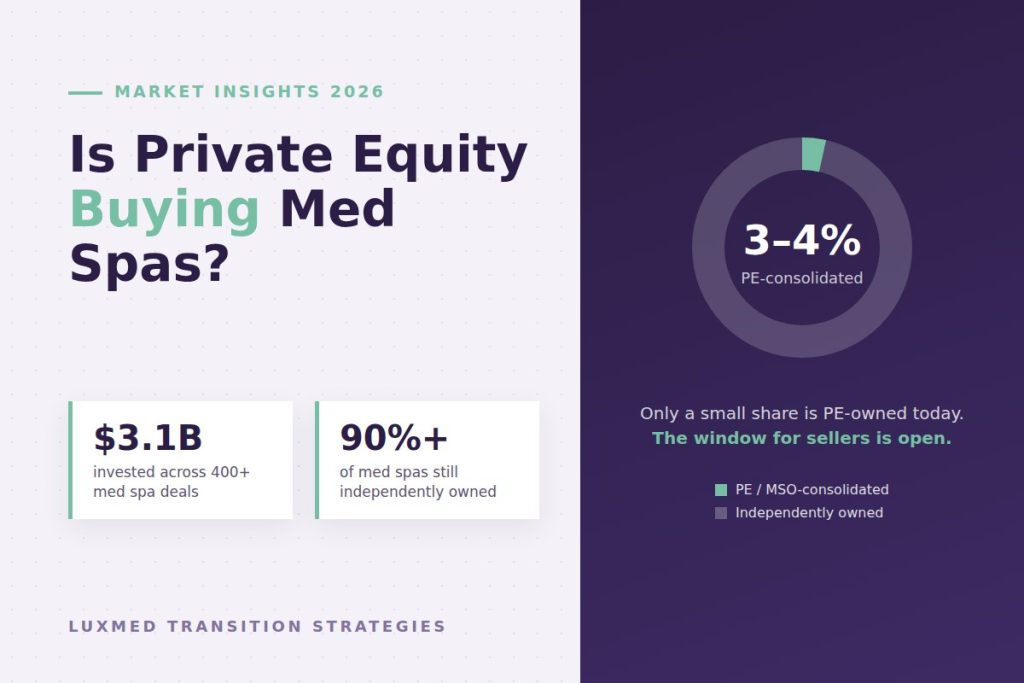
Here is something most owners do not realize. Over 90% of med spas in the US are still independently owned. Only 3% to 4% are currently owned by PE-backed platforms (American Med Spa Association, 2024). That means the wave of buying and consolidation that already happened in dentistry and dermatology is just now reaching med spas.
Private equity interest in med spas isn’t limited to a handful of firms. Beyond the PE-backed platforms already actively acquiring, there is a broad and growing network of MSOs, private equity firms, family offices, strategic acquirers and other buyers evaluating opportunities in the space. With more than 90% of med spas still independently owned and buyer interest continuing to grow, attractive practices can generate meaningful competition among buyers.
What “Second Bite of the Apple” Actually Means
Some deals with PE-backed buyers include rollover equity, meaning the owner reinvests a portion of the sale proceeds into the larger platform rather than receiving the entire amount in cash at close.
Here is why that matters. If the larger platform continues to grow and later sells or goes through a recapitalization, that rollover equity may provide an additional payout. In the industry, that future payout is called the “second bite of the apple.” The amount and structure of rollover equity vary by deal, and any future payout depends on the performance of the platform and is not guaranteed.
The Catch With Keeping a Slice
Here is the part most owners do not hear enough about. Keeping a slice and getting a second payday later is not the same as a clean exit today. It means a portion of your proceeds remains invested in the larger platform. Nothing about that second payday is promised.
A second payday can be a real win, especially if you understand the deal you are stepping into. Before agreeing to any structure built around a future payout, get clear on exactly what you are getting into and who is running that bigger business.
Factor Two: Where Your Practice Stands in Its Own Growth
Growing Businesses Sell for More
Buyers look at what your practice is earning today, but they also pay close attention to its trajectory. A practice with more patients, room for additional providers and growing revenue tells a buyer that growth will likely keep going after the sale. That story earns a higher price.
Why Waiting Until Retirement Backfires
Here is where timing gets tricky. Many owners plan to sell right when they are ready to slow down and retire. That makes sense personally. It often hurts you financially.
As an owner gets closer to retirement, they naturally see fewer patients and do less work. Their numbers drop. A buyer does not see that drop as “the owner is just slowing down.” They see declining numbers, and declining numbers usually mean a lower price. The moment you finally feel ready to sell may be the same time your practice’s performance has started to decline.
The Sweet Spot You Want to Hit
From a valuation perspective, the best time to sell is while your practice is still growing, not after you have already started slowing down. That may mean deciding to sell years earlier than you naturally would want to retire, while your numbers are still climbing instead of dropping.
Using Your Prep Time to Hit Both Factors
You only need one plan to handle both factors. Use the time before a potential sale to clean up your finances and train your team to run things without you. That same time also keeps your business growing, which means you can sell while your numbers are still climbing, not after they start to drop.
The earlier you start getting ready, the more time you have to make real, believable changes that show up in your numbers. Use that time to keep growing, not to slow down. That way you catch the market’s good timing and your own good timing at the same moment.
So, Is Now the Right Time for You?
Right now, buyer activity in the med spa market remains strong, and there are still plenty of independently owned med spas. That can create favorable conditions for sellers.
The other part depends on you. If your practice is still growing, your numbers are strong, and you are not yet easing into retirement, you may be in exactly the sweet spot described above. If you are already slowing down, the smartest move might be finding ways to grow again before you sell, not selling right away.
Either way, guessing is not a plan. The smartest next step is getting a clear, real answer about where your practice actually stands today.
Frequently Asked Questions
Is now a good time to sell a med spa?
Current buyer activity can create favorable conditions for sellers, but whether now is the right time for you also depends on your practice’s performance, growth and your personal goals.
What is a “second bite of the apple” in a med spa sale?
Some med spa deals include rollover equity, meaning you reinvest a portion of your sale proceeds into the larger platform. If that platform later sells or goes through a recapitalization, your equity may provide an additional payout, sometimes called a “second bite of the apple.”
Does my practice’s growth really change how much it is worth?
Yes. Buyers pay for what they think will happen next, not just what already happened. A growing practice usually sells for more than one where the numbers have started dropping, which often happens naturally as an owner nears retirement.